Muscle Base for Dye Sub Suits: How Printed Muscle Shading Creates That Superhero Look
Ever notice how some printed cosplay suits look like the wearer just stepped off a comic panel, with a defined chest, cut abs, and popping shoulders, while others look like plain colored spandex? The difference usually isn’t the body inside the suit. It’s the muscle base printed onto it.
I’m Mark, the creator behind 4NEO Designs, and muscle shading is baked into every single design I make. It’s one of the most-asked-about parts of my process, and honestly, it’s the main reason a dye sub suit reads as “superhero” instead of “pajamas.” Today I’m breaking down exactly what a muscle base is, how it works in dye sublimation, and every way you can get one on your own suit, including a free template you can download right now.
Let’s get started!
What Is a Muscle Base?
A muscle base is a layer of muscle shading built directly into a dye sublimation suit design. Instead of relying on padding or foam, the highlights and shadows of a muscular physique (pecs, abs, delts, quads) are painted into the artwork itself, then printed permanently into the fabric. When you wear the suit, light and shadow do the rest, and your body looks sculpted from every angle.
Every design in my catalog includes a muscle base as the foundation layer. The suit colors, logos, and textures sit on top of it, which is why a 4NEO suit has that dimensional, screen-ready look straight out of the package. No gym membership required.

Why Muscle Shading Is the Secret to the Superhero Look
Think about your favorite movie suits: the Spider-Man suits, the Flash, Black Panther. None of those actors are walking around with their bare physique doing all the work. Costume designers build definition into the suit through texture, paneling, and shading. A muscle base does the same job for cosplayers, at a fraction of the cost and weight.
Here’s what printed muscle shading gets you:
- Definition without bulk: The shading creates the illusion of muscle, so the suit stays as light and breathable as plain spandex. You can wear it all day on a con floor without overheating.
- It never shifts or sags: Unlike padding, printed shading can’t slide out of place mid-photoshoot. It’s part of the fabric, permanently.
- It photographs beautifully: Camera flashes love printed shading. The contrast reads as real depth in photos, which is where most of your cosplay lives anyway.
- It works for every body type: A good muscle base is scaled to your measurements, so the anatomy lands in the right places whether you’re slim, broad, or anywhere in between.
Muscle Base vs. Muscle Suit: What’s the Difference?
These two get mixed up constantly, so let’s clear it up. A muscle base is printed shading: flat artwork that creates the illusion of muscle. A muscle suit is a physical undersuit with foam or padding sewn in to change your actual silhouette.
- Choose a muscle base if you want definition, comfort, and a suit that works straight off the printer. This covers most superhero builds.
- Choose a muscle suit if your character has an exaggerated physique (think Hulk, Bane, or bodybuilder-tier heroes) where shading alone can’t add the mass you need.
- Combine both if you want maximum impact: a padded undersuit for silhouette, with a printed muscle base on top to sharpen the definition.
If padding is the route you need, I wrote a full guide on how to make a muscle suit that walks you through the whole process.
How a Muscle Base Works in Dye Sublimation
If you’re new to dye sub, here’s the short version of how the shading actually ends up on your suit:
1. The Shading Is Painted Into the Pattern File
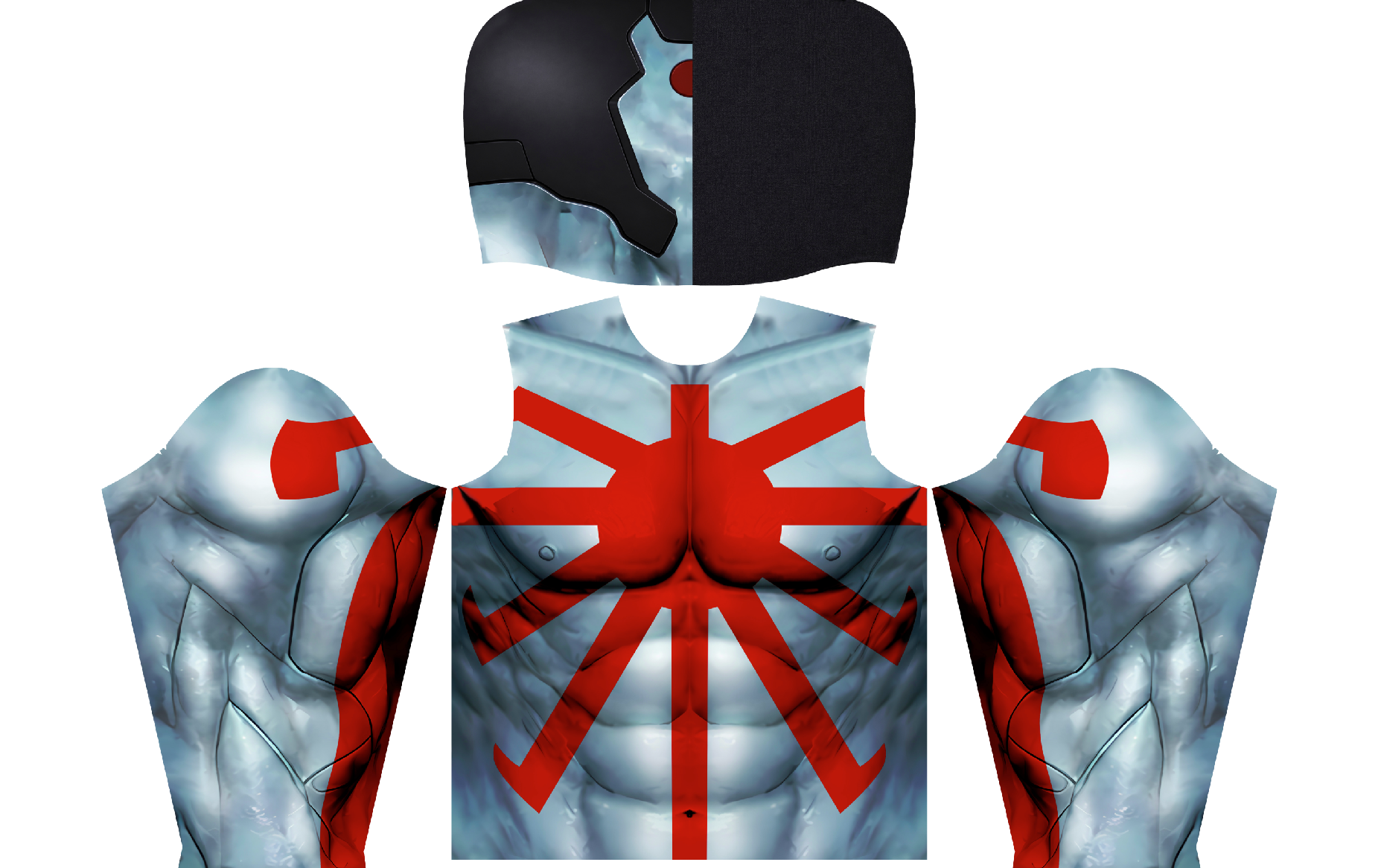
A dye sub suit starts as a flat digital pattern: all the panels of the suit laid out like a sewing pattern. The muscle base is digitally painted onto those panels, with anatomy positioned so everything lines up when the suit is sewn together. This is the step where experience matters most, because shading that looks great flat can land in the wrong spot on a body.
2. The Design Is Printed and Pressed Into the Fabric
Dye sublimation printing turns the ink into gas under heat and bonds it with the polyester fibers themselves. The shading isn’t sitting on top of the fabric like paint; it becomes part of the fabric. It won’t crack, peel, or wash out, and the fabric stays just as stretchy as it was before printing. If you’re weighing your options, here’s my full comparison of dye sublimation vs screen printing for cosplay.
3. The Suit Is Sewn and the Shading Comes Alive
Once the printed panels are sewn into a suit, the flat shading wraps around your body’s real curves. Stretch is part of the design math too: a good muscle base accounts for how the fabric stretches when worn, so the abs don’t end up wide and blurry across your stomach.
Want to see how this fits into a complete build? My DIY superhero costume guide covers the full journey from idea to con floor.
4 Ways to Get a Muscle Base for Your Suit
Depending on your budget, timeline, and how custom you want to go, there are four routes. I’ve ordered them from “free and DIY” to “fully done-for-you.”
1. Download My Free Muscle Base Template
If you’re designing your own suit, don’t start from a blank canvas. I offer a free muscle base template that gives you that classic superhero physique as a foundation layer. Drop it under your design, adjust it to your pattern, and build your colors and logos on top. It’s the exact same starting point I use for client work.
2. Shop Ready-Made Designs
Every pattern in my shop already includes muscle shading as part of the design. That’s thousands of superhero suits, ready to print. Earlier versions of my muscle bases are also available there if you want a different style of shading to work into your own projects.

3. Commission a Custom Muscle Base
Maybe you’ve tried DIY-ing it and the anatomy keeps landing wrong, or your character needs shading that doesn’t exist in any template. That’s what commissions are for. I’ll build a muscle base scaled to your measurements and styled to your character: subtle and realistic, bold and comic-styled, whatever the look calls for. If you’re running into problems getting the look you’re after, reach out and we’ll figure it out together.
4. Paint Your Own From Scratch
If you’re comfortable in Photoshop, Procreate, or Clip Studio, you can paint your own shading using anatomy references. It’s the most work, but it’s also how I learned. Start with the free template anyway, because reverse-engineering how the highlights and shadows are placed will teach you faster than starting from zero.
7 Tips for Making Printed Muscles Look Real
Whether you’re using my template or painting your own, these are the tips I give everyone who asks in my Discord.
1. Keep the Opacity Subtle
The number one beginner mistake is shading that’s too dark. Real muscle definition is soft gradients, not hard black lines. If your shading looks bold on screen, it will look painted-on in person. Dial the opacity back until it almost disappears. That’s usually the sweet spot.
2. Work From Real Anatomy References
Comic art exaggerates, but it exaggerates from real anatomy. Keep reference photos open while you work, and pay attention to where muscles actually attach and overlap. Wrong anatomy is the thing people can’t unsee, even if they can’t name what’s off.
3. Scale to Your Measurements
A muscle base designed for someone 6’2″ will put the abs in the wrong place on someone 5’8″. Before printing, make sure the shading is scaled and positioned for your torso length, chest width, and limb proportions. This is the single biggest factor in whether the final suit looks custom or costume-shop.
4. Mind the Seam Lines
Shading has to flow across seams. If the deltoid shading on the front panel doesn’t line up with the back panel, the illusion breaks at every seam. Check the transitions on every panel edge before you send anything to print.
5. Test Print Before Committing
Colors and contrast shift between screen and fabric. What looks subtle on a monitor can print darker or flatter than expected. If your printer offers swatches or a small test panel, use it. One cheap test saves an expensive reprint.
6. Choose Fabric That Holds Detail
Dye sub needs polyester-based fabric, and the weave matters. A smooth, high-quality spandex blend holds fine gradient detail; cheaper, looser weaves blur it. If the shading is the star of your suit, don’t let the fabric undercut it.
7. Match the Shading Tone to Your Suit Colors
Muscle shading shouldn’t be plain gray on every suit. Shade with a darker tone of the panel color: deep blue shadows on a blue suit, warm red-browns on a red suit. It keeps the suit looking unified instead of like a gray skeleton showing through the colors.
Running Into Problems? You’re Not Alone
Muscle shading is one of those skills that looks easy until you try it, and that’s okay. If your shading keeps coming out too harsh, the anatomy won’t sit right, or you’re just not getting the look you see in your head, you’ve got two good options.
First, come hang out in the 4NEO Designs Discord. It’s where I answer questions about the process, and there’s a community of cosplayers working through the same builds you are. Bring your work-in-progress. Fresh eyes catch things fast.
Second, if you’d rather skip the trial-and-error entirely, commission me. I’ve spent years building muscle bases for every body type and character style, and I’ll get you the look you’re trying to accomplish, tailored to you and ready to print.
Conclusion: The Muscle Base Makes the Suit
That superhero look you’re chasing isn’t about the body in the suit. It’s about the shading printed into it. A good muscle base adds definition, depth, and that straight-off-the-screen presence, all without a single piece of padding.
Start with the free muscle base template, browse the ready-made designs in my shop, or commission something fully custom. And whichever route you take, the Discord is always open when you have questions. Now go make something heroic.
Key Takeaways
- A muscle base is printed muscle shading built into a dye sublimation design. It creates the superhero physique without padding.
- Every 4NEO design includes one: it’s the foundation layer that makes a printed suit look dimensional instead of flat.
- Muscle base vs. muscle suit: shading creates the illusion of definition; a padded muscle suit changes your actual silhouette. Big characters may need both.
- Four ways to get one: the free template, ready-made shop designs, a custom commission, or painting your own.
- Subtlety wins: soft gradients, real anatomy, correct scaling, and seam alignment are what make printed muscles look real.
Frequently Asked Questions
What is a muscle base in cosplay?
A muscle base is muscle shading printed directly into a dye sublimation costume design. The highlights and shadows of a muscular physique are painted into the suit’s artwork, so when the suit is printed and worn, it creates the appearance of defined muscles without any padding or foam. It’s the main reason printed superhero suits look dimensional instead of flat.
What’s the difference between a muscle base and a muscle suit?
A muscle base is flat printed shading that creates the illusion of muscle definition, while a muscle suit is a physical padded undersuit that changes your actual body shape. A muscle base adds definition with zero bulk or heat; a muscle suit adds real mass for characters with exaggerated physiques. Many advanced builds combine both.
Is there a free muscle base template I can use?
Yes. 4NEO Designs offers a free muscle base template that gives you a classic superhero physique as a starting layer for your own dye sublimation designs. Download it, scale it to your pattern, and build your suit’s colors and logos on top of it.
Can I add a muscle base to a suit design I already have?
Usually, yes. If you have the design file, a muscle base can be layered underneath your existing colors and details before printing. The key is scaling the shading to your measurements and aligning it with your pattern’s seams. If you’re not sure how, a commission or a question in the 4NEO Discord is the fastest way to get it sorted.
Does muscle shading wash out or crack over time?
No. Dye sublimation bonds the ink with the polyester fibers themselves rather than printing on top of the fabric. The muscle shading is permanently part of the material. It won’t crack, peel, or fade in the wash, and the fabric keeps its full stretch.